December 3rd, 2019

Two-phase orthodontic treatment involves two separate and distinct periods that your child receives orthodontic treatment. It allows your son or daughter to begin early treatment of bite and jaw problems, in order to reduce the dental issues he or she experiences later on.
Two-phase orthodontic treatment with Dr. Trevor Bonilla can improve how well the second phase of the treatment works and helps to make room for permanent teeth. Overall, two-phase treatment helps to position the teeth and the jaw for an attractive profile. Our team at Ideal Orthodontics recommends that you bring your child to our Coppell, TX office at the age of seven or eight, so that Dr. Trevor Bonilla can determine if early (Phase-One) treatment is necessary.
Phase-One
Phase-One orthodontic treatment is known as early treatment. It begins shortly after your child’s first orthodontic examination, usually around age eight or nine. The main goal of Phase-One orthodontic treatment is to help make room for permanent teeth, which reduces crooked teeth as a result of overcrowding. It treats the jaw and bite growth, and issues like crossbite or underbite. This can reduce the need for your child to undergo extractions.
Phase-Two
Phase-Two orthodontic treatment is when braces are placed on the upper and/or lower teeth. The purpose is not just to correct spaces or misaligned teeth, but also to correct overbite or underbite concerns. Phase-Two usually begins around age 11 or 12, and the braces are worn for an average of two to three years, depending on your child’s unique needs. Some children have fewer issues and wear braces for little more than a year, while others need them for up to four years.
Signs your child needs two-phase orthodontic treatment
If your child exhibits the following signs, he or she may be a good candidate for two-phase orthodontic treatment:
- Losing baby teeth early, before five years of age
- Problems with biting or chewing
- Sucking the thumb after age five
- Evidence of a crossbite, where the teeth don’t come together when opening or closing of the mouth
- Teeth are crowded at age seven or eight
- Protruding teeth on the top or bottom
Not all children need to have early treatment, but if your child shows any of these signs, you should bring him or her to us for an evaluation at Ideal Orthodontics.
November 26th, 2019
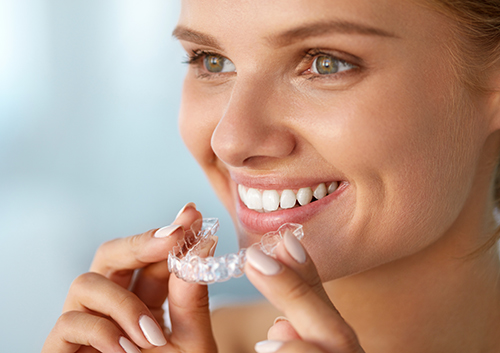
You may have a talent for home repairs. You may be able to rebuild your computer. You may even be able to put together a whole room of furniture armed only with flat-box kits and an Allen wrench. But, please—don’t try do-it-yourself orthodontics!
Now that generic clear aligners are available, you might consider giving them a try to save some money. But is straightening your own teeth really a good idea? Before you are tempted, let’s look more closely at the products and the dental science involved.
Invisalign®
- Invisalign clear aligners are used by orthodontists and dentists with experience in custom treatment for your smile. A 3D image of your teeth will be captured by the iTero Element® scanner. Using special software, your doctor can map out each projected shift in your teeth, and even show you a projection of your finished smile!
- Your Invisalign aligners will be tailored to fit your teeth precisely using the 3D scan and 3D printing. They are made from SmartTrack® material, a product specifically engineered for a perfect, comfortable fit. Invisalign aligners are even trimmed to fit your individual gumline to prevent irritation.
- When your first sets of Invisalign aligners arrive at our Coppell, TX office, Dr. Trevor Bonilla will check for fit, answer any questions you might have about use and care, and let you know what to look for and what to expect. Your progress will be monitored with visits every six to eight weeks. (And for parents of teens, Invisalign aligners can offer blue “compliance indicators” to let you know they are being worn the 20-22 hours a day necessary for the best and fastest results.)
Generic Aligners
- You might be required to make a putty mold of your own upper and lower teeth, which is not the easiest thing to do well, and to take selfies of your teeth.
- The aligners will be sent to you in the mail. They are generally made of hard plastic with generic gumlines. There will be no one to tell you if the aligners fit properly.
- They are sometimes less expensive because there is no in-person medical supervision. A dental professional working for the company will look at the model created from molds you submit, and recommend a series of aligners to correct the problems he detects by looking at the model and your selfies. This supervisor will not be able to assess the overall dental health of each patient to make sure teeth and gums are healthy and ready to start treatment, and will not be able to tell if the teeth are moving properly or improperly once the aligners are in use.
Finally, while generic aligners may potentially have some success in minor tooth straightening, they are not created to deal with complex bite issues or malocclusions. In fact, using generic aligners with no supervision can cause more serious dental problems than a patient started with.
Sure, sometimes a do-it-yourself project turns out well. But your teeth and bones are too important for home improvement. When it comes to creating a beautiful, even smile and balanced, comfortable bite while making sure of your dental health, it’s always best to trust a professional like Dr. Trevor Bonilla to provide you with gentle, tested, and successful care!
November 19th, 2019

Nowadays, many adults are taking advantage of getting straighter teeth with braces. Dr. Trevor Bonilla and our team love to help patients create the dazzling, confident smile they’ve always wanted.
Our adult patients usually fall into two categories: some had braces in the past but didn’t wear their retainers, while others are brand-new to wearing braces. Either way, both groups want the same thing: straighter teeth and a beautiful smile!
You will have several options for getting braces, depending on your financial situation and how quickly you would like your treatment to finish. Traditional metal braces are a less-expensive option and can help people who have severely crooked teeth. But many adults may not prefer this option because they dislike the appearance of metal brackets.
If you’re concerned about how you’ll look, we offer clear ceramic braces that aren’t as visible. These are more expensive than metal braces, and patients need to be careful with colored drinks that can stain them, such as coffee or red wine.
Another popular option is a clear aligner treatment called Invisalign®. This type is practically invisible; it uses a series of aligners that are customized to fit your teeth. The process of straightening your teeth can last anywhere from three to 18 months. For people who have extreme bite problems or crowded teeth, a different method may work better.
Don’t hesitate to call our Coppell, TX office today to set up a consultation. Dr. Trevor Bonilla will help you choose the best option so you can be on your way to a straighter, more confident smile!
November 12th, 2019

Great question! Tooth movement is your body’s natural response to light pressure applied by braces over a period of time (usually two years). Braces work by using brackets that are glued onto your teeth; these brackets have small slots, and that is where Dr. Trevor Bonilla and our team insert orthodontic wires. These wires are held in place by small elastic ties that fit around the brackets. As time passes during your treatment, these wires apply pressure on your teeth, which sets in motion the movement of your teeth into their desired positions. Each of your teeth has a different size and shape to them, as do the brackets. Each bracket is custom-made for the particular tooth on which it’s supposed to fit.
Not long ago, orthodontists had stainless steel wires and that was about it. Today, however, we have a number of different high-tech wires at our disposal to move your teeth faster and more comfortably.
When you first get your braces on, the first wire or two will typically be very flexible, but still strong enough to apply a constant force on your teeth. As your teeth straighten out over time, however, Dr. Trevor Bonilla will use progressively thicker and firmer wires to help move your teeth in place for an ideal bite.
Every time you visit our office for an adjustment, we will swap out the wires in order to keep putting pressure on your teeth, which is why it’s so important for you to keep your adjustment visits during your treatment. Most adjustment appointments are scheduled four to eight weeks apart to give your teeth time to move.
As for rubber bands and elastics, most of our patients will need to wear elastics or rubber bands at some point during their treatments. These elastics typically go from one or more of the upper braces to one or more of the lower braces, and pull on your teeth to move them in the direction they need to move in order to achieve an optimal bite.
If you have any questions about wires, brackets, or elastics, or have any general questions about your treatment, please give us a call at our Coppell, TX office.